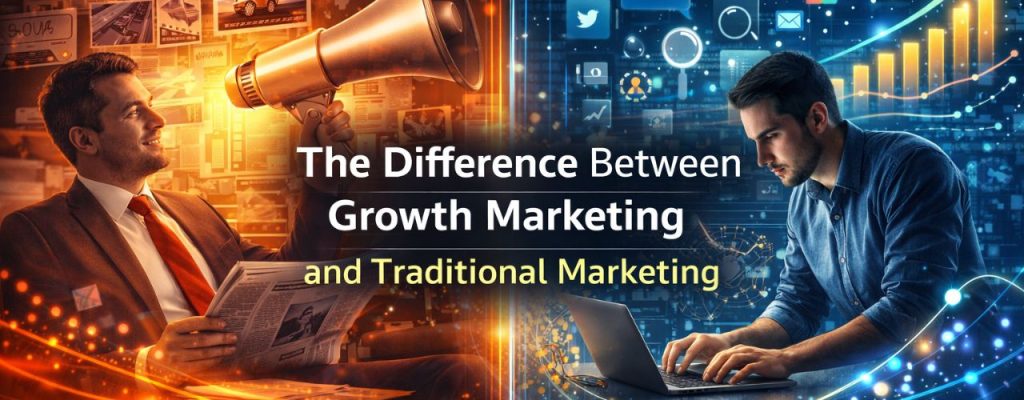
Marketing has evolved significantly over the years, shifting from broad, one-way communication to data-driven, customer-focused strategies. Two of the most commonly discussed approaches today are growth marketing and traditional marketing. While both aim to promote businesses and drive results, they differ in execution, mindset, and long-term impact. Understanding these differences can help businesses choose the right approach for sustainable growth.
What Is Traditional Marketing?
Traditional marketing refers to conventional methods of promoting products or services. This includes channels like print advertisements, television commercials, radio ads, billboards, and even basic digital ads.
The primary focus of traditional marketing is brand awareness and reach. Businesses aim to get their message in front of as many people as possible, hoping to attract potential customers. Campaigns are usually planned in advance, launched for a fixed period, and measured based on visibility metrics such as impressions or reach.
While traditional marketing can be effective for building brand recognition, it often lacks precise targeting and real-time adaptability. Once a campaign is live, making changes can be difficult and costly.
What Is Growth Marketing?
Growth marketing, on the other hand, is a modern, data-driven approach that focuses on the entire customer journey—from awareness to retention and beyond. It combines marketing, analytics, and experimentation to drive continuous improvement.
Instead of relying on one-time campaigns, growth marketing emphasizes testing, learning, and optimizing. Marketers use techniques such as A/B testing, performance tracking, and user behavior analysis to refine strategies in real time.
The goal is not just to acquire customers, but to engage, convert, and retain them. Growth marketing focuses on measurable outcomes like conversions, customer lifetime value, and retention rates.
Key Differences Between Growth Marketing and Traditional Marketing
One of the biggest differences lies in their approach to data. Traditional marketing relies more on assumptions and broad audience targeting, while growth marketing uses real-time data to make informed decisions.
Another key difference is flexibility. Traditional marketing campaigns are often fixed and linear, whereas growth marketing is dynamic and constantly evolving based on performance insights.
Additionally, growth marketing focuses on the full funnel. It does not stop at customer acquisition—it also works on improving onboarding, engagement, and retention. Traditional marketing, in contrast, is usually centered around the top of the funnel.
Which Approach Works Better?
The answer depends on business goals. Traditional marketing is useful for building mass awareness and establishing a brand presence, especially for large-scale campaigns.
However, in today’s competitive digital landscape, growth marketing offers a significant advantage. Its focus on data, personalization, and continuous optimization makes it more effective for businesses looking to achieve measurable and scalable results.
Finding the Right Balance
Rather than choosing one over the other, many successful businesses combine both approaches. Traditional marketing can create initial visibility, while growth marketing ensures that this visibility translates into meaningful engagement and conversions.
Conclusion
The difference between growth marketing and traditional marketing lies in their mindset and execution. Traditional marketing focuses on visibility, while growth marketing prioritizes measurable growth and long-term customer relationships.
Businesses that embrace data-driven strategies and continuously optimize their efforts are more likely to stay ahead in the evolving marketing landscape.